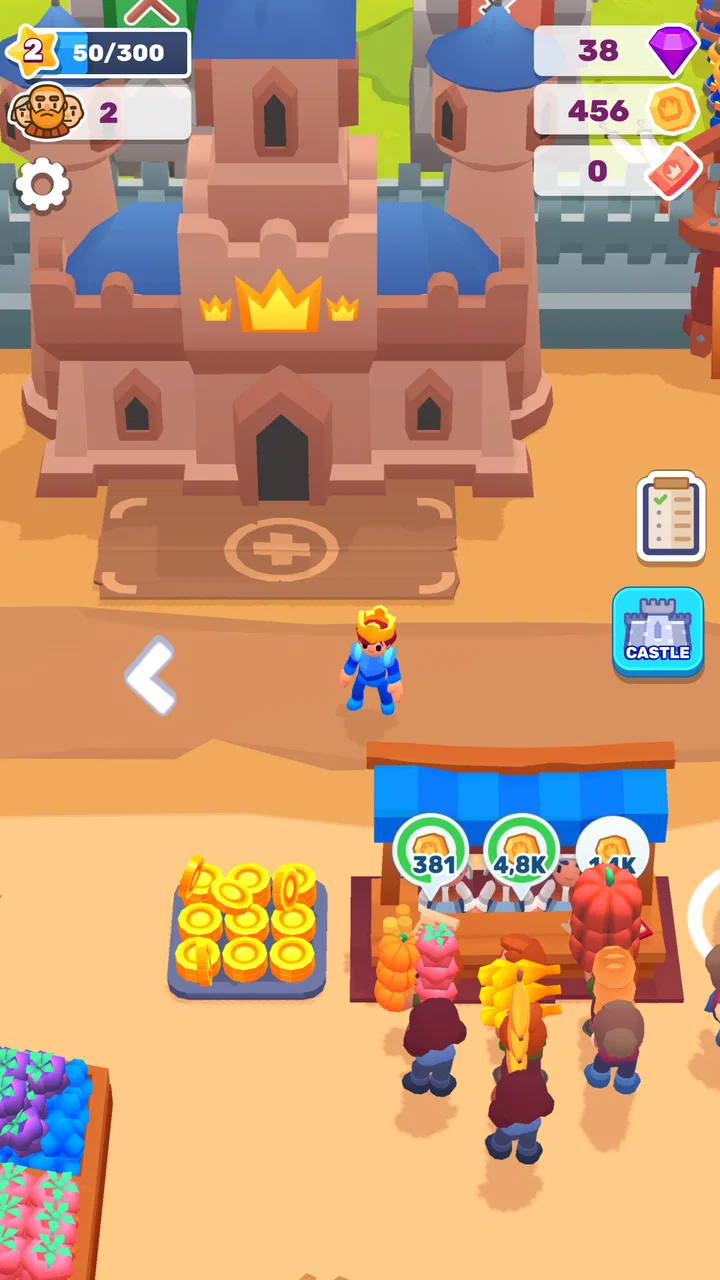
Royal Lands - Save The King
- 4.7
- Rating
- 500.00K
- Installs
- Free
- Price

 Analysis by App-foxy
I approached Royal Lands - Save The King as the sort of role-playing game that can sit on a shared phone and invite short turns rather than demanding that one person disappear into a huge fantasy world for hours. Its central idea is easy to understand: help protect people, build up a castle, and gradually shape a kingdom. That makes it immediately approachable, especially when someone wants a light medieval game instead of a complicated strategy simulator.
My overall impression is positive, but with an important qualification. This is best enjoyed as a casual progression game, not as a deep substitute for a large-scale kingdom management title. The appeal comes from seeing your little realm become more established and making decisions that feel connected to its survival. The experience is easier to share when each player respects the current state of the kingdom, because the game is designed around one ongoing save rather than separate household profiles.
How Royal Lands fits into a shared household
A realistic use case is a family tablet or a phone that several people pick up during the day. One person might play while waiting for an appointment, another might check the castle after dinner, and a younger player could enjoy the rescue-and-building theme without needing to understand a dense ruleset first. That rhythm suits the game better than treating it like a competitive session where everyone must be present at the same time.
You May Also Like

 Blood Strike: 2.5 Anniversary
Blood Strike’s Loadouts Turn Every Drop Into a Tactical Gamble
A close look at Blood Strike’s custom loadouts: how fast access to signature weapons reshapes its battle royale rhythm, rewards preparation, and narrows the gap between fights.

 Pandora - Music & Podcasts
Pandora’s Music Is Easy to Start, but Harder to Recover
Pandora’s strength is its low-effort path from a seed to a station. Its weak spot is how much confidence it asks you to place in connection, setup, and quiet recovery.

 8 Ball Pool
 Is Built on Rivalries, Rematches, and Routine
A close look at the rivalries, rematches, shared routines, and unanswered safety questions that turn a quick pool match into a persistent mobile community.

 Samsung Music
’s Quiet Strength Is Playing What You Already Own
Its reach comes less from spectacle than from dependable access to a personal library. That simplicity is both the app’s strongest retention engine and its ceiling.

 AccuWeather: Weather Radar
AccuWeather Review: A Quick, Clear Forecast for Everyday Decisions
For everyday plans, the best forecast is the one you can understand quickly. AccuWeather makes rain timing, radar, and local conditions easy to act on, with a few trade-offs.

 Hill Climb Racing
Why Hill Climb Racing Still Turns Crashes Into One More Run
A tiny car, a bumpy hill and one more upgrade: Hill Climb Racing keeps resurfacing because its simple chaos makes every near-miss feel personal.
More From Our News Desk
View All News


The shared-device strength is also its first practical limitation. If two people use the same installation, they should agree on what counts as a sensible decision before anyone starts spending resources or changing the direction of the kingdom. A child may focus on the most visible upgrade, while an adult may prefer to save for a more useful improvement. Neither approach is automatically wrong, but the next player may feel that the previous turn removed an option they were planning to use.
I found that the most comfortable arrangement is to treat each visit as a small handover. The person finishing a session can briefly say what they changed and what they intended to do next. That simple habit matters more here than it would in a disposable puzzle, because castle growth creates a sense of ownership even when the device itself belongs to the household.
The game’s free entry also helps with casual sharing. You can try its basic loop without paying upfront, which lowers the barrier for a family member who is unsure whether medieval role-playing is their kind of game. At the same time, optional purchases range from $1.99 to $119.99 per item, so a shared device deserves a clear household rule about spending before anyone plays.
What the first sessions feel like
The opening experience is built around a straightforward fantasy promise: the kingdom needs attention, people need help, and the castle should become stronger. I liked that the theme gives ordinary progress a reason. An upgrade is not merely a number going up; it can be understood as part of restoring order and making the realm more secure.
For a new player, the useful question is not “How quickly can I unlock everything?” but “Which action makes the next visit easier?” I recommend looking for improvements that support continued progress rather than spending every available resource on the most attractive option. That mindset is especially valuable on a shared device, where the next player may inherit a kingdom with little flexibility left.
There is a gentle learning curve here, but the accessible presentation should not be mistaken for unlimited depth. Players who want intricate troop formations, extensive diplomacy, or a highly detailed economic model may find the decisions lighter than expected. The role-playing label fits the adventure and progression framing, yet the game remains closer to a streamlined mobile experience than to a long-form computer role-playing game.
Setting boundaries before anyone plays
Because the game is free to start and includes in-app purchases, I would make the spending boundary explicit before installing it on a household device. Decide whether purchases are allowed at all, whether only one adult can approve them, and whether the game should be played only when the device owner is present. These are household choices rather than game mechanics, but they directly affect whether the experience stays relaxed.
I would also agree on a simple rule for irreversible-looking choices: pause and ask before making one if another person is actively invested in the kingdom. Even without assuming a particular save system or account arrangement, shared play becomes less frustrating when players avoid treating a common world as personal territory.
Another useful boundary is time. Royal Lands works well in short visits, but a player who keeps returning only to chase the next improvement can turn a pleasant routine into a repetitive obligation. In my experience, it is healthier to stop after a clear goal—such as completing a small building task or helping a group of inhabitants—rather than continuing simply because another upgrade is visible.
For adults managing a shared phone, the safest approach is to handle store-account settings outside the game and not rely on the game itself to provide household supervision. I would not hand the device to a child with an open purchasing method and assume the game will solve that problem. The important protection is the boundary established around the device and its store account.
Coordinating progress without taking over
Coordination works best when each player has a defined role in the household routine, even if the game does not formally assign roles. One person can focus on checking the kingdom and identifying the next sensible objective, while another can handle a short building session later. This avoids the common shared-game problem where everyone taps through the same early actions without knowing why.
A small note beside the device can be surprisingly effective: record the current priority, the resource being saved, and any decision that should wait. This is not necessary for solo play, but it prevents duplicated effort when several people use the same installation. It also gives younger players a way to participate in planning rather than simply pressing the most obvious button.
I would avoid letting the fastest or most experienced player monopolize every important decision. The game’s accessible premise makes it suitable for teaching a child how progression works: save a little, choose an improvement, observe the result, and adjust. If an adult always optimizes the kingdom, the younger player may see only the finished outcome and miss the satisfying reasoning in between.
On the other hand, coordination should not become a committee meeting. The attraction of a mobile role-playing game is that it can be picked up casually. A good compromise is to discuss major spending or direction changes, while allowing each person to handle routine progress independently. That keeps the game playful instead of turning a shared device into a household management project.
Age, tone, and trust
The content rating is Everyone 10+, which places the game in a broadly accessible space while acknowledging that its fantasy conflict and rescue theme may suit older children better than very young players. I would consider it a reasonable choice for a child who already understands that the castle and its dangers belong to a fictional setting, especially when an adult is nearby for the first sessions.
The more important age question is not whether a child can understand the basic objective. The game’s premise is clear enough for that. The practical question is whether the child can handle progression choices and the presence of optional purchases responsibly. A ten-year-old who can follow a spending rule may have a good time; a younger child who taps quickly on every attractive option may need closer supervision.
Trust also matters between players. If a teenager and a parent share the same kingdom, both should accept that the other may make different but reasonable choices. I would not recommend this arrangement for people who become annoyed when someone else changes their preferred plan. In that situation, separate devices or a different game with clearer individual boundaries would be more comfortable.
The developer is SayGames Ltd, and the game has attracted a 4.7 average from around 14 thousand ratings, with over 500 thousand installs. That level of adoption suggests that the approachable kingdom premise has found an audience, but popularity should not replace a household trial. The right fit depends more on whether everyone enjoys the same light progression rhythm than on the public score.
Where it stands beside familiar alternatives
Compared with a traditional role-playing game, Royal Lands asks for less preparation and less commitment. You do not need to learn a large fictional history before understanding why the castle matters. That makes it a better choice for a shared phone, where a player may have only a few minutes and may not remember a complicated storyline from the previous evening.
Compared with a dedicated city builder, its kingdom theme gives progress more personality, but players seeking extensive layout control or detailed production chains may want something more specialized. The trade-off is clear: Royal Lands is easier to enter and easier to explain, while a deeper builder can reward long planning sessions with more complicated consequences.
It also differs from competitive kingdom games that revolve around alliances, rankings, or pressure from other players. The appeal here is more personal and local: improve the realm in front of you and help its people. That makes it calmer for household use, although anyone looking for constant social competition may find the experience too contained.
My most useful comparison is with idle progression games. Royal Lands shares the satisfaction of returning to a developing world, but its castle-and-rescue framing gives those returns a clearer narrative purpose. The weakness of that format is that the routine can become predictable if you need every session to introduce a dramatic new idea. Players who prefer frequent surprises should approach it as a steady companion rather than an endlessly changing adventure.
Practical advice for a better household routine
First, choose a shared objective before handing over the device. “Improve the kingdom” is too vague; “save toward the next useful castle improvement” gives the next player a clear direction without dictating every tap. This reduces accidental spending and makes short sessions feel connected.
Second, let new players observe one complete cycle before asking them to make important choices. A child can learn more by seeing how helping people and strengthening the castle relate to one another than by receiving a long explanation of every visible option. Once the basic rhythm is clear, give them a modest decision and discuss the result afterward.
Third, do not judge progress only by how much the castle changes visually. In a shared game, a good session may simply preserve resources, complete a useful task, or leave the kingdom in a better position for the next person. This prevents the household from rewarding rushed decisions over thoughtful ones.
Finally, check the current version before troubleshooting an unusual problem. The version shown for the game is 1.3.1, and it requires Android 8.0 or later. Those details matter when an older household phone is involved, particularly if the device is used by a child and cannot be replaced easily.
My household verdict
I would recommend Royal Lands to a household that wants a friendly, free-to-start medieval game with a clear sense of restoration and gradual growth. It is particularly suitable when different people take short turns on one device and are willing to communicate about the kingdom. The castle theme is easy to explain, and the rescue focus gives younger players a more understandable reason to care about progress than a purely numerical builder might offer.
I would skip it for a household looking for separate profiles, strict individual progression, or a highly detailed strategy system. I would also choose another game for anyone who dislikes optional purchases, repetitive return visits, or the possibility that a shared save can become a source of disagreement. The free price makes trying it easy, but the purchase range means adults should establish controls before sharing the device.
After playing it, I see the strongest version of this game as a small communal routine: one person checks the realm, another completes a building goal, and everyone agrees on the next priority. That is more modest than the promise of ruling a vast fantasy empire, but it is also where the game feels most natural. Royal Lands is at its best when the kingdom is shared casually, not managed competitively.
For my own recommendation, I would install it on a suitable household device, explain the spending rule, and let each player have a short turn before deciding whether the progression holds their attention. Its Everyone 10+ rating, approachable role-playing structure, and steady castle-building idea make that trial worthwhile. Just keep expectations realistic: this is a light kingdom adventure from SayGames Ltd, not a replacement for a deep strategy campaign or a fully separate family gaming system.
FAQs for Royal Lands - Save The King
01What is the main objective of Royal Lands - Save The King?
Royal Lands - Save The King is a strategy-based game where players must build and manage their kingdom, protecting it from invaders and ensuring the safety of the king. The game combines resource management, tactical combat, and kingdom expansion, offering an immersive experience that challenges players to think strategically.
02Is Royal Lands - Save The King available for both Android and iOS?
Yes, Royal Lands - Save The King is available on both Android and iOS platforms. You can download it from the Google Play Store for Android devices and the Apple App Store for iOS devices, ensuring a wide range of users can enjoy the game across multiple devices.
03Are there in-app purchases in Royal Lands - Save The King?
Yes, Royal Lands - Save The King offers in-app purchases. These purchases can enhance gameplay by allowing players to acquire special items, resources, and upgrades more quickly. However, the game is designed to be fully enjoyable without spending money, providing a balanced experience for all players.
04What are the system requirements to play Royal Lands - Save The King?
To play Royal Lands - Save The King, your device should meet the minimum system requirements. For Android, this typically means a device running Android 5.0 or higher with at least 2GB RAM. For iOS, the game usually requires iOS 10.0 or later. Check the app store for specific compatibility details.
05Does Royal Lands - Save The King offer multiplayer options?
Yes, Royal Lands - Save The King features multiplayer options. Players can engage in battles with others online, forming alliances or competing against each other to protect their kingdoms and save the king. This adds a social and competitive element to the game, enhancing the overall experience.
Pros
- Engaging storyline with plot twists.
- Intuitive controls for easy gameplay.
- Rich graphics enhance immersion.
- Varied missions keep it interesting.
- Regular updates with new content.
Cons
- In-app purchases can be pricey.
- Occasional connectivity issues.
- Battery drain on older devices.
- Some levels feel repetitive.
- Ads can be intrusive at times.

Royal Lands - Save The King
Gallery